
01 / BACKGROUND
Economics is about choices, not money.
When I began teaching sixth-grade economics, my school had no curriculum and the state standards were so broad they suggested no obvious path forward. I was—and am—convinced that we’re in an era of profound economic change, and the lessons on job fairs and capitalism versus communism I found online felt irrelevant to the future my students would inhabit.
I wanted to help my students see economics as a tool for thinking about the world. Concepts like scarcity, incentives, opportunity cost, and unintended consequences can help them navigate everyday decisions. At a larger scale, economics offers a way to consider how societies decide what they value, whom they trust, and how to share a finite world.
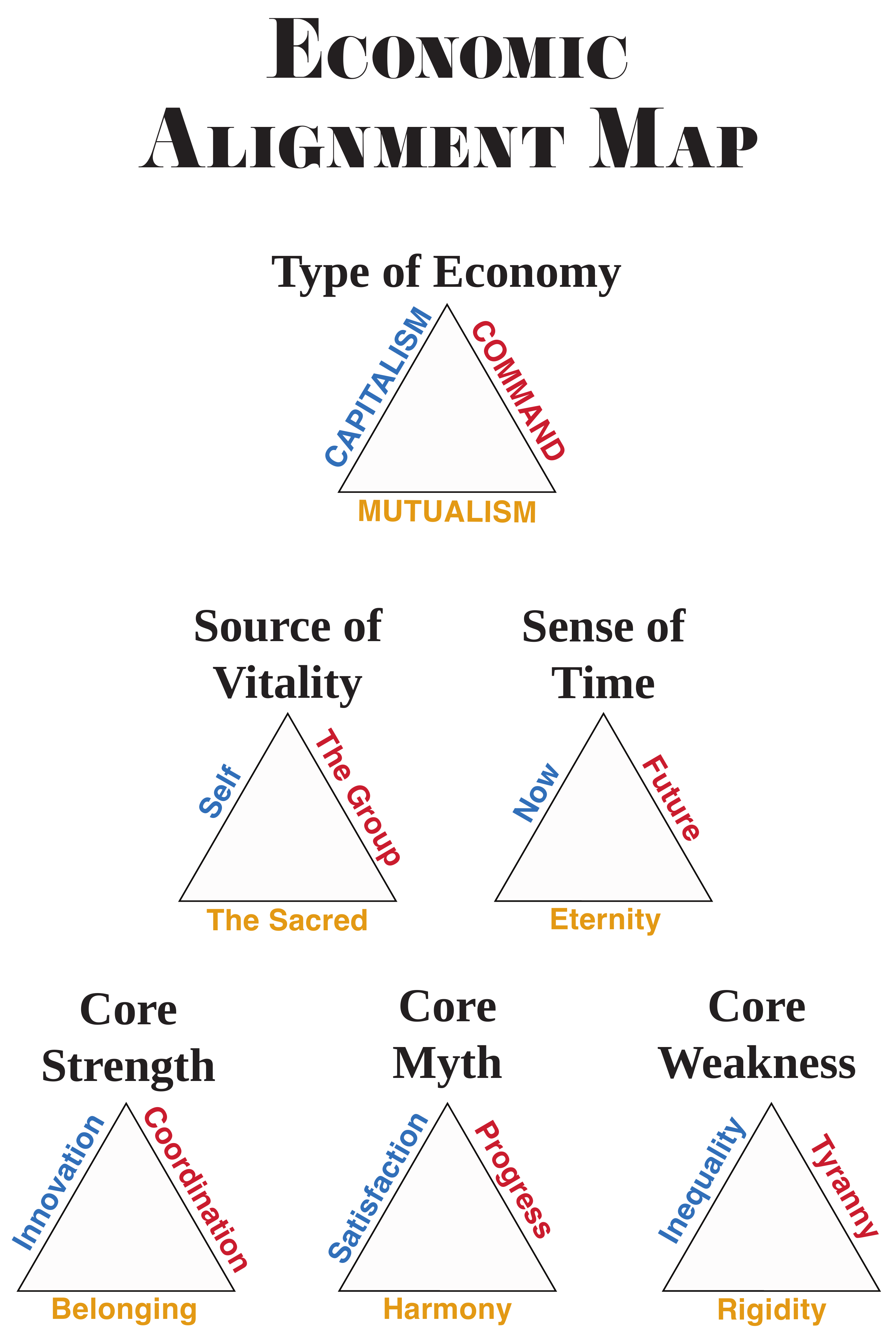
I developed an Economic Alignment Map organized around three archetypal systems—capitalism, command economies, and mutualism. Though all modern societies blend these models, the simplification helped me think through the values that produce, and are produced by, each system. With this framework, we could ask deeper questions: Who should decide? What do we owe one another? What are we willing to sacrifice for prosperity, fairness, freedom, safety, or the future?
In a world where life is precious and resources are scarce, what do we value, and how do we live responsibly?
02 / PURPOSE
Write the book they want to read.
One day, I noticed a student ignoring my presentation while voraciously reading The Hunger Games. That gave me the idea: I would write a young-adult adventure novel. I didn’t have a year of sustained effort to do it, so I knew AI would be key. The result was a five-chapter science-fiction adventure in which the characters explore a world where each economic system is represented by a distinct civilization.
The challenge was to help students experience different economic systems instead of flattening them into competing lists of advantages and disadvantages. Every society needed to work in its own way, appeal to different people, and carry unique costs.
03 / THE CIVILIZATIONS
Five societies.
No perfect answers.
Umuofia
The travelers’ agrarian home is organized around tradition, shared responsibility, and survival. Famine has pushed its existing system to the limit, sending the expedition out in search of knowledge that might save the village without destroying what holds it together.
The Forest
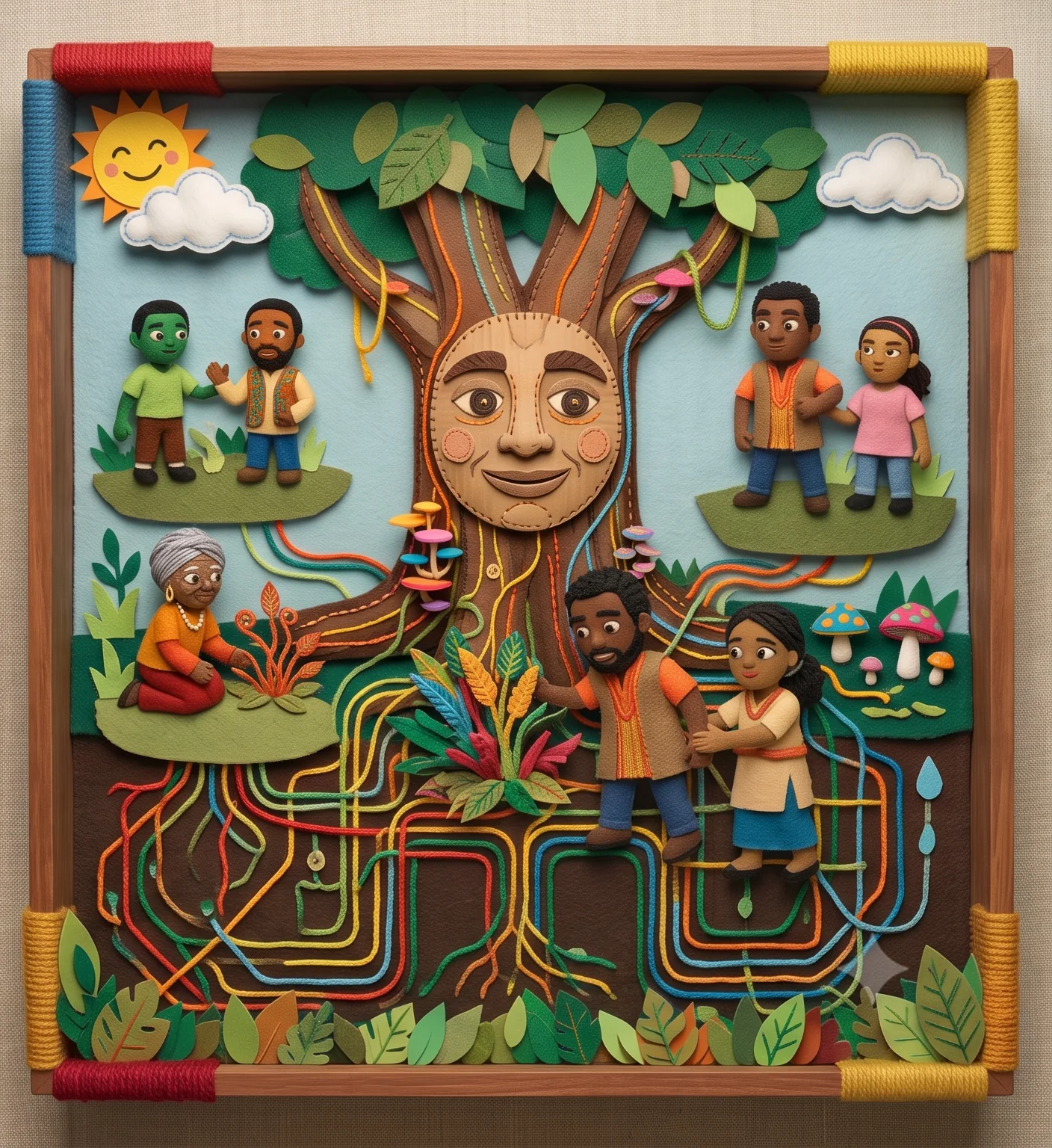
The Forest protects ecological continuity. Its artificial intelligence is woven into roots, fungi, soil, water, and other living systems. Its restraint is wise but painful when the travelers find a medicinal plant that might save someone they love and are forbidden to harvest it before it produces seeds.
Capital City
Capital City creates innovation, abundance, and the possibility of advancement. Citizens earn points determining access to food, work, housing, and status. The opportunities are real, but so are humiliation, inequality, and the quiet disappearance of people who no longer fit.
The Common Reach
The Common Reach uses planning and forecasting to keep anyone from falling too far. The society is calm, fair, and secure, but slow to change. A pump that could help feed Umuofia is delayed because adopting it would disrupt too many parts of The Shared Forecast.
The Alignment
The Alignment takes the desire for order to its final conclusion. Artificial intelligence is no longer a tool used by society; it has become the environment itself. Hunger, pain, conflict, and uncertainty can all be removed—but only inside a system with no meaningful outside.
Each society preserves something valuable. Each also shows what can happen when one value expands until it begins to crowd out all others.
04 / PROCESS
Let the economics emerge from conflict.
My initial draft had an instructional-design problem disguised as a story problem: characters arrived, observed a system, discussed it, and moved on. They behaved like students on a field trip.
I rebuilt each chapter around a more demanding sequence: a character needs something; a society offers a tempting solution; people disagree; a choice is made; the choice creates a cost; the travelers leave changed. Concepts moved out of explanation and into decisions with physical and emotional consequences.
A detailed Story Bible held the economic logic, technologies, character arcs, recurring images, vocabulary, and reading level together. I used generative AI heavily for production speed, possibility generation, diagnosis, revision, and continuity checking—but not as a one-prompt story generator. The more the tool could produce, the more precisely I had to define the story’s purpose and constraints.
The chapters were divided by functional subheadings for classroom reading and discussion. We read each chapter together, then students completed vocabulary and comprehension work. The final day of each cycle used Thinking Maps to trace cause and effect, organize evidence, examine character decisions, and compare societies before we moved on.
05 / ASSESSMENT
Students write the ending.
The most important instructional decision was not to write the final chapter.
At the end of Chapter 5, the travelers have rejected The Alignment’s promise of perfect abundance. They must return to a village that is still hungry, carrying fragments of knowledge, partial technologies, warnings, and fewer seeds than they left with. They know every system has costs, but they have not been handed a correct answer.
For the final project, students wrote a 500–1,000-word sixth chapter. They decided what the travelers told Umuofia, which ideas or technologies they brought home, what the village changed, what limits it preserved, and what new tradeoffs followed. Their stories had to incorporate incentives, tradeoffs, cooperation, specialization, technology, and unintended consequences.
This made the conclusion an assessment of economic thinking rather than story recall. Students could not succeed by merely repeating definitions or taking the story in an unrelated direction. They had to consider what had already happened, make choices through narrative, and accept their consequences. Most importantly, they had to recognize that systems are built around values, choices have tradeoffs, and every solution changes the people living inside it.